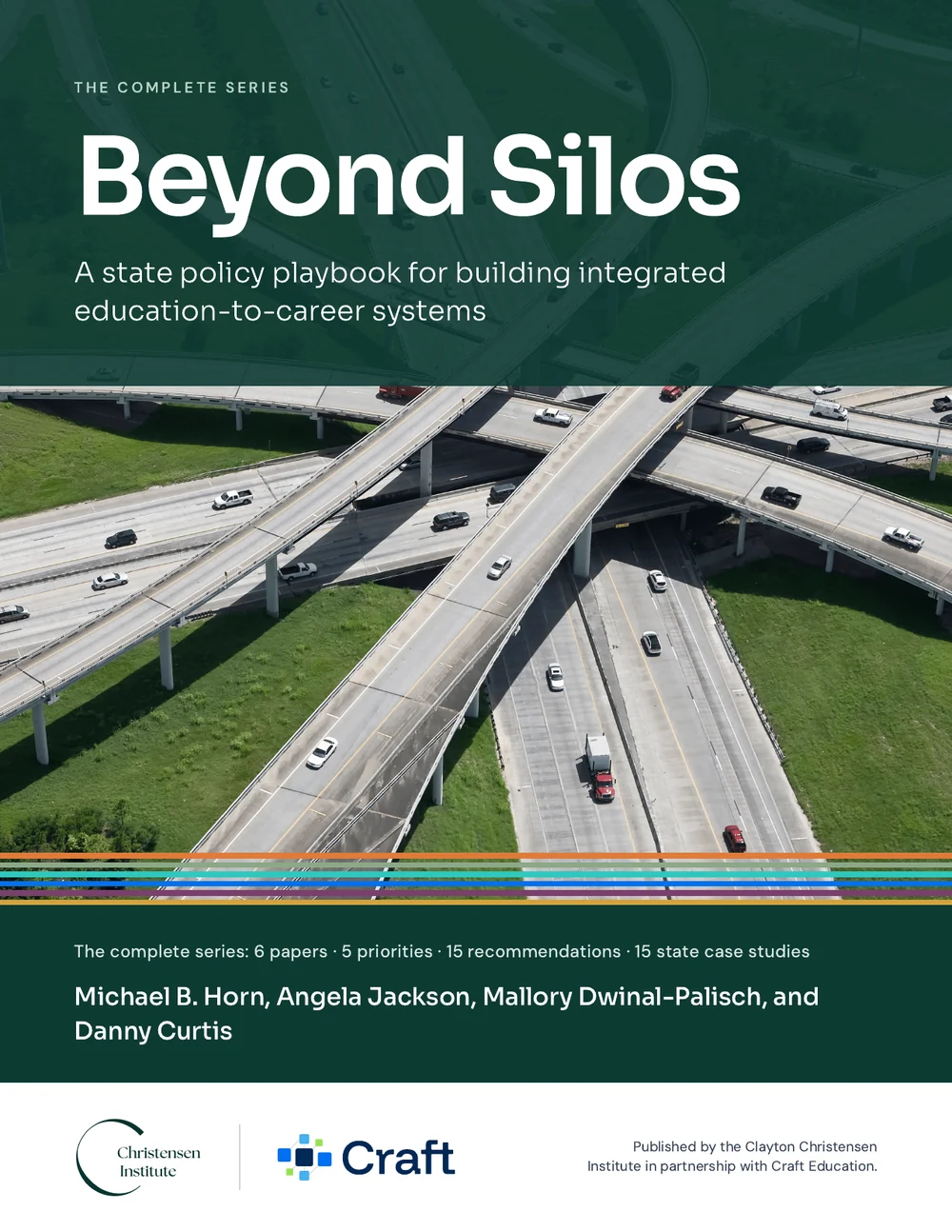
Beyond Silos: The Complete Series
A state policy playbook for building integrated education-to-career systems, co-published with the Clayton Christensen Institute. Six papers, five priorities, fifteen recommendations, and fifteen state case studies drawn from eleven states.
What's inside
Co-published with the Clayton Christensen Institute and authored by Michael B. Horn, Angela Jackson, Mallory Dwinal-Palisch and Danny Curtis. Craft commissioned the series; the Institute brought the research.
It was written for a specific person. Governors keep calling for more work-based learning, more apprenticeships, more pathways that lead somewhere. The agency leaders asked to deliver on those calls keep returning to the same question: what policies, funding and programs do we actually need to make this happen?
One apprenticeship can involve a school district, a college, an employer, and more than one state agency. Each has its own rules, funding streams, and definitions of success. Most of those rules exist for good reasons. Together, they can make a sensible program very hard to build.
Two Lenses
What separates this from most policy writing is that it asks why the barriers exist before proposing to remove them.
- Business Model Theory. Clayton Christensen's framework for what organizations are structurally able to do well. Value proposition, resources, processes, financial formula. The argument: many policy ideas fail not because they are wrong, but because they are incompatible with how colleges, districts and training providers actually operate. States are powerful members of those value networks, so state policy shapes what providers can take on.
- Chesterton's Fence. Understand why a barrier exists before removing it. Find the fence, learn why it was built, then renovate: keep the purpose, change what no longer serves learners. The series calls this careful renovation, not demolition.
Five Priorities
Each priority comes with three recommendations.
- 01 Getting a view and setting a vision across systems. Cross-agency governance and strategy, requiring and supporting collaboration, informing strategy with shared data. Case studies: the Texas Tri-Agency Workforce Initiative, the Arkansas Governor's Workforce Cabinet, the Maryland Longitudinal Data System.
- 02 Revise requirements to recognize learning across contexts. Making space for work-based learning, evaluating learning for college credit, adjusting licensure. Case studies: Indiana's graduation requirements redesign, SUNY's Credit for Prior Learning policy, Alabama's Student Nurse Apprentice Permit.
- 03 Changing how funding flows. Seeding new programs, shifting funding toward outcomes, making funding follow students. Case studies: the California Apprenticeship Initiative, Texas State Technical College's returned-value funding formula, Indiana's Career Scholarship Accounts.
- 04 Create statewide infrastructure to power local programs. Shared data and resources, investing in bridging, reducing employer liability barriers. Case studies: the Colorado Workforce Development Council, Louisiana Jump Start regional partnerships, Apprenticeship Carolina.
- 05 Strengthen the pull of career-connected pathways. Expanding career guidance and building demand. Case studies: Utah's HB 555 youth apprentice reforms, Maryland's Career Counseling Program, the Alabama Talent Triad.
How to read it
Each of the six papers stands on its own. Read the series straight through, or go directly to the priority that matches the problem on your desk. Each recommendation is paired with a deep dive into how one state put it into practice, fifteen case studies across eleven states.
The case studies describe how individual states approached specific challenges. Their inclusion is not an endorsement by the Clayton Christensen Institute or Craft Education of every policy discussed.
Who it's for
State agency leaders and civil servants doing the actual work of connecting education, workforce and labor systems. Governors' offices, workforce boards, state education and higher education agencies, and the policy staff who get asked to deliver on career pathway commitments and then discover the rules were never written to work together.
Get this resource
Fill this in once and the file opens right away.
We'll email you about new resources. Unsubscribe any time.
Next live session
Register NowWatch on demand
Drop your work email and the recording opens in a new tab.
We'll email you about new resources. Unsubscribe any time.
Get this resource
Drop your work email and the PDF opens right away.
We'll email you about new resources. Unsubscribe any time.