Teacher apprenticeship is a design question for educator preparation: how coursework, clinical practice, employment, mentorship, and evidence can operate as one coherent pathway rather than as parallel systems. Many EPPs already have important foundations in place. The work is to connect them with intention.
As candidate affordability, enrollment patterns, district hiring needs, and expectations for measurable outcomes reshape educator preparation, institutions face a strategic choice: whether to help design job-embedded pathways with the academic, partnership, and quality-assurance infrastructure candidates and schools need. Teacher apprenticeship creates a way to connect employment, coursework, mentorship, clinical practice, and progression around a shared candidate-development model.
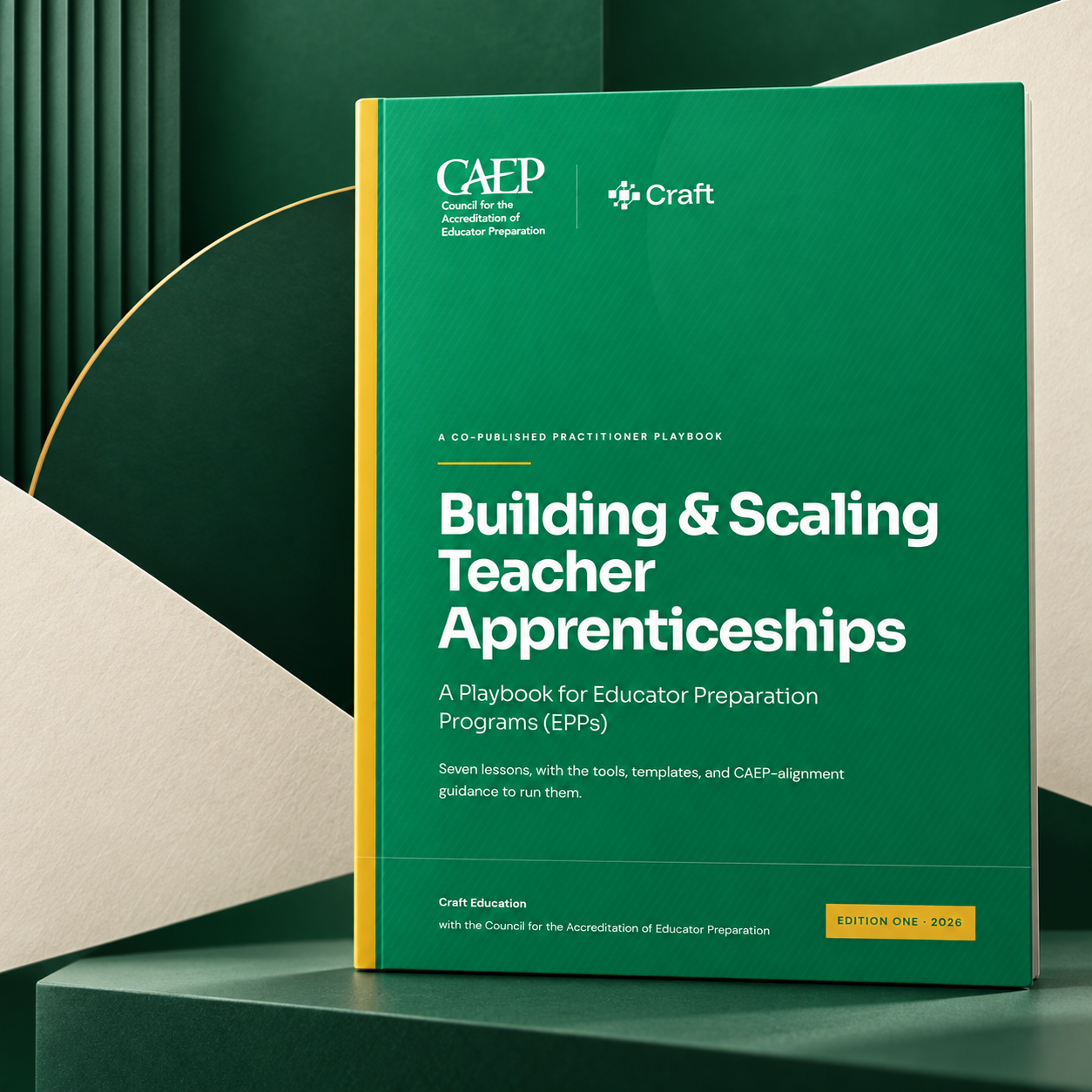
As a nonprofit workforce platform supporting registered apprenticeship and work-based learning, we help employers, districts, and postsecondary institutions design, register, and track apprenticeship programs. We co-published Building & Scaling Teacher Apprenticeships: A Playbook for Educator Preparation Programs (EPPs) with the Council for the Accreditation of Educator Preparation (CAEP) to help institutions identify what is already in place, decide what needs to be designed, and choose a first move that fits their context.
What teacher apprenticeship requires from an EPP
Teacher apprenticeship is often summarized as earning while learning. Compensation is an important part of the model, but it is not the whole model.
A formal Registered Apprenticeship Program, or RAP, intentionally connects paid classroom work to five components:
- On-the-Job Learning (OJL): Paid, supervised work in a real setting where candidates build skills over time.
- Related Technical Instruction (RTI): Structured, often credit-bearing instruction that supports the knowledge candidates need for the role.
- Mentorship and supervision: Ongoing guidance and feedback from experienced educators, coaches, or supervisors.
- Progressive skill development: Clear competencies or milestones that show how responsibility and capability increase.
- Wage progression: In a RAP, compensation advances as apprentices meet milestones and demonstrate growth.
The defining feature is coherence. A complete pathway connects work, instruction, feedback, and advancement rather than leaving them in separate systems.
That distinction matters for EPPs with paid student teaching, residency, Grow Your Own, or paraprofessional-to-teacher pathways. Those can be strong foundations. Payment or employment alone does not establish a RAP; the connected structure above and the applicable registration process do.
In the playbook, we use apprenticeship-aligned to describe the work of connecting existing strengths before an institution decides whether formal registration is the right next step. An EPP can improve the alignment of coursework, clinical practice, and partnerships without immediately becoming a sponsor or launching a full apprenticeship degree.
What EPPs and districts must connect
EPPs retain academic oversight. Faculty remain responsible for instruction, assessment, rigor, and candidate evaluation. Districts and mentor teachers bring the daily work context, workplace learning, and feedback that candidates need to develop in practice.
Across the EPP, district, sponsor, intermediary, and mentor-teacher roles, responsibilities are complementary:
- An EPP may provide RTI, academic support, assessment, and degree oversight.
- A district or school system may employ candidates and provide OJL.
- A RAP sponsor oversees standards, registration, compliance, and reporting.
- An intermediary can coordinate partners and support implementation.
- Mentor teachers model practice, coach candidates, and provide feedback without replacing faculty assessment.
This operating model moves beyond placement coordination. Partners jointly define what candidates will learn, when responsibility will grow, how mentors will be supported, how feedback will be used, and what evidence will show progress.
In the playbook, RTI and OJL are designed to reinforce one another. Coursework can help candidates make sense of the work they are doing now while clinical learning builds progressively through clear competencies. A course might ask candidates to apply an instructional strategy that week, analyze a real classroom challenge, or use mentor feedback to inform their next decision.
State licensure rules, institutional degree authority, accreditation standards, and federal or state apprenticeship oversight remain in place. Apprenticeship connects the work taking place within those systems.
Choose a practical starting point
We recommend a bounded entry point that your institution can support. A useful first step may be one program, one course, one district partnership, or one candidate cohort.
Start by having your team answer a few concrete questions:
- Which candidates are already working in schools, and what learning supports do they need?
- Where do coursework and clinical practice already align, and where are the disconnects?
- Which partner would own employment, RTI, mentorship, sponsorship, and coordination?
- What is one assignment, responsibility milestone, or partnership practice the team could test in the next 60 to 90 days?
Those questions show what can be adapted within current structures and what requires further institutional, state, or partner review. They also prevent teams from treating funding, data, and partnership roles as afterthoughts.
In our guide, we encourage teams to build sustainability and evidence into planning. We call this braided funding: aligning institutional, district, workforce, and philanthropic resources around a shared apprenticeship goal, with each source supporting the components it is designed to fund. Availability and eligibility vary. Teams can also connect existing data, including candidate progression, program experience, retention and completion, employment and placement, and partner feedback, to decisions made during the program.
For CAEP-accredited providers, the CAEP Alignment Crosswalk helps teams organize those design choices and evidence sources in relation to standards R1 through R5. It supports alignment, evidence development, and program improvement. It is not an accreditation decision or a guarantee of an outcome.
Download the full playbook
We built the playbook for the work that follows a promising idea. It includes a readiness reflection, RAP-component and role-mapping tools, course and competency exercises, partnership-planning materials, funding and data resources, a 90-day planning template, FAQs, and the CAEP Alignment Crosswalk.
Download Building & Scaling Teacher Apprenticeships: A Playbook for Educator Preparation Programs (EPPs) and use its materials with your EPP, district, workforce, and sponsorship partners.
.webp)